



|
|
|
|
We cooperate with Fons Trompenaars on entries concerning Russia. If you are interested in participating in this research project, please go to the contact page and send us a message.
Several tools of the kind
are used by THT, one of them is the Intercultural Awareness Profiler:
" Many of the questions in the profiler are taken from real-life or business
situations. There are no right or wrong answers - only your view of the world.
The questions are designed to differentiate between cultures and may appear
personal and probing.
In the full questionnaire, there are a wide spectrum of questions. The following
is just one example.
Life Scenario
You are riding in a car driven by a close friend, and he hits a pedestrian.
You know he was going at least 45 mph in an area of the city where the maximum
is 30mph (50 km/hour). His lawyer says that if you testify under oath that his
speed was only 30mph (50 km/hour), it may save your friend from serious consequences.
There are no other witnesses.
What right does your friend have to expect you to protect him?
• As a friend he has a definite right to expect me to testify that he
was only going 30mph (50 km/hour).
• As a friend he has some right to expect me to testify that he was only
going 30mph (50 km/hour).
• As a friend he has no right to expect me to testify that he was only
going 30mph (50 km/hour).How did you answer ?
This question is an example of a dilemma. You are forced to choose between two
seemingly opposing values.
• concern for the law (you wouldn't protect your friend)
• concern for the relationship you have with your friend - where it may
be more important than some abstract legal principle
Universalism - Particularism
The dimension universalism-particularism concerns whether one feels a stronger
obligation to laws, rules, codes, and procedures, and applies them universally
to everyone, or whether one feels a stronger obligation to particular situations
and special relationships. In a predominantly universalistic culture, a universal
system of abstract rights and obligations take precedence over particular exceptions
or circumstances. Universalists are inclined to follow the rules - even when
friends are involved - and look for "the one best way" of dealing
equally and fairly with all cases.
Particularist societies are those in which particular circumstances are more
important than rules. Bonds of particular relationships (family, friends) are
stronger than any abstract rules. One's response to a situation may change according
to the circumstances and the people involved. Particularists often argue that
"it all depends".
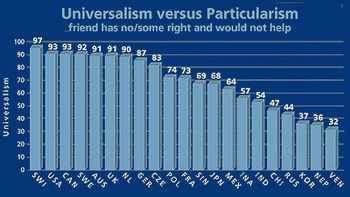
Your score
on this dimension ?
By combining your responses to a number of different questions we can compute
your score on this (and other) dimensions.
Consider where you may be on this scale - ( between 100=a total universalist
through to 0= a total particularist). "
For more information about Fons Trompenaars' work, please visit THT web site
at: www.thtconsulting.com